
If you asked a clinic administrator ten years ago what patient intake meant, they probably would have pointed to a clipboard.
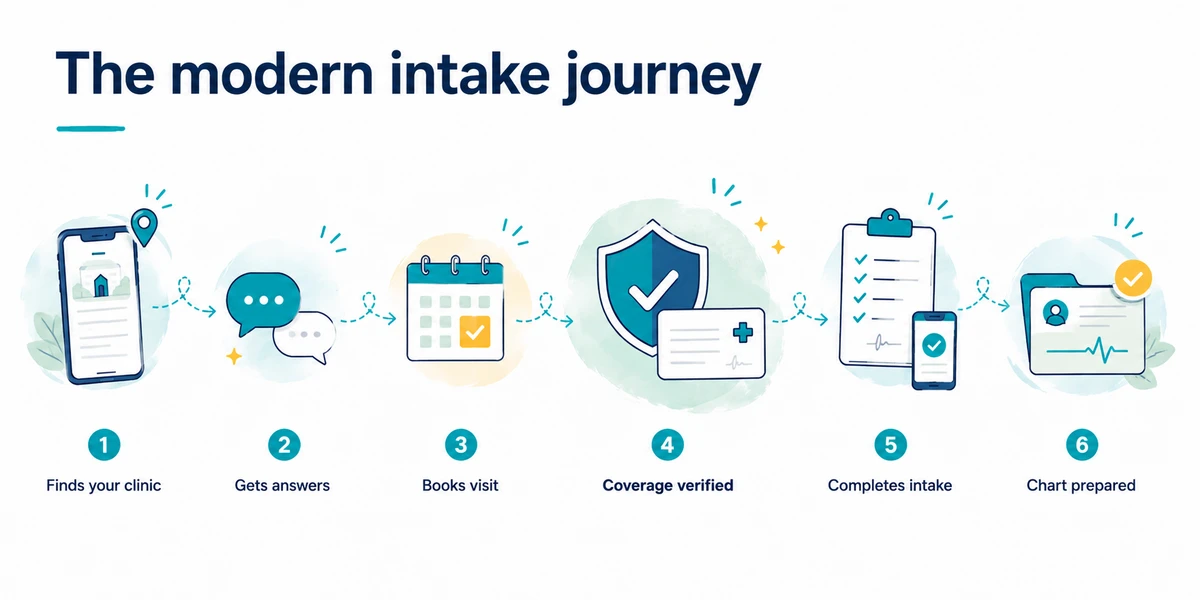
Today, patient intake software has become much more than a digital version of paperwork. The best systems handle registration, insurance verification, consent collection, scheduling, communication, chart preparation, and much more.
That is good news for clinics. It also makes evaluating software much harder. Almost every vendor claims to save time, most promise better patient experiences, and many advertise automation.
The real question is whether the software actually improves operations or actually moves the work somewhere else. If you're evaluating patient intake software, here are the questions worth asking.
Start with the patient experience
Patients rarely judge a clinic based on the technology behind the scenes, but instead judge it based on how easy things feel. Can they complete registration from their phone? Does the process take two minutes or twenty? Are they repeatedly entering information they've already provided?
The best digital patient intake forms feel simple because a lot of complexity is being handled behind the scenes. When evaluating solutions, look for:
- Mobile-friendly intake forms
- Easy insurance card upload
- Multi-language support
- Electronic consent collection
- Accessible design for less tech-savvy patients
If the intake process feels frustrating to patients, staff usually end up handling the fallout later.
The Patient Intake Stress Test
Answer three quick questions about your current process.
Real-time eligibility verification should be standard
This is one area where there is a meaningful difference between systems. Pretty much all platforms collect insurance information, but some actually verify it which is a distinction that matters.
If eligibility is not checked until after registration, staff may still need to manually verify coverage. If verification runs in batches, issues may not be discovered until much later. Strong insurance eligibility verification software validates coverage while intake is happening.
That means:
- Coverage issues are identified before the visit
- Demographic mismatches can be corrected immediately
- Front desk staff spend less time on manual verification
- Claims are less likely to deny for eligibility-related reasons
Many clinics think they have automated eligibility verification when they really have automated data collection. These are not the same thing.

Most eligibility problems are not difficult to fix. The problem is discovering them after the visit.
Look beyond forms and think about communication
One of the biggest shifts happening in healthcare operations right now is that intake is becoming conversational. By that we mean patients increasingly expect to schedule appointments, ask questions, and complete registration without waiting on hold or exchanging multiple emails. This is where communication tools become important.
Some systems now include:
- Automated SMS follow-up
- Appointment reminders
- Website chat widgets
- Voice-based scheduling assistants
- Recall and reactivation workflows
For example, newer AI caller technology can answer common questions, collect insurance information, schedule appointments, help fill last-minute cancellations, and provide a transcript for staff review afterward. Whether or not a clinic needs every one of these features, the broader trend is clear: intake is becoming more interactive.
Make sure the system actually talks to your EMR
This sounds obvious, but it is often where clinics run into trouble. Many intake systems collect information successfully, but staff still have to copy demographics into the EMR, insurance cards still need to be uploaded manually, and consent forms end up stored in separate systems.
When evaluating software, ask:
- Does patient information populate directly into the chart?
- Does insurance information transfer automatically?
- Are completed forms attached to the patient record?
- Is the integration API-based or dependent on manual workflows?
A patient should only need to enter information once and the software should handle the rest.
Don't forget consent tracking and audit trails
This is not the most exciting feature category, but it becomes important quickly. Consent management is easy when everything goes right but definitely becomes much more important when someone needs to answer questions like:
- Did the patient sign this form?
- Which version did they sign?
- When was it signed?
- Can we retrieve it easily?
Good patient intake software should provide:
- Electronic signatures
- Time-stamped records
- Consent version tracking
- Audit logs
- Easy retrieval during audits or disputes
Most clinics don't think about these features until they need them. When they do need them, they become very important.
Analytics matter more than most clinics realize
Many intake platforms stop at data collection. The better ones help clinics understand what is happening operationally.
For example:
- How many patients abandon intake?
- How many appointments are scheduled online?
- Which insurance issues occur most frequently?
- How long does intake take on average?
- How many eligibility problems are being caught before visits?
Those insights can help clinics improve workflows over time instead of simply digitizing existing problems.
Basic vs. modern intake platforms
Instead of a long paragraph, here is how a basic intake system compares to a modern intake platform at a glance:
| Feature | Basic Intake System | Modern Intake Platform |
|---|---|---|
| Digital Forms | ||
| Insurance Upload | ||
| Real-Time Eligibility | ||
| EMR Integration | Limited | |
| Consent Tracking | Basic | |
| AI Caller / Scheduling | ||
| Analytics | Limited |
Simple visuals like this tend to perform very well because readers immediately understand the difference.
The checklist
If you only remember one thing from this article, make it this: Good patient intake software should do more than collect forms.
When evaluating platforms, ask whether it includes:
- Digital patient intake forms
- Real-time insurance eligibility verification
- EMR integration
- Electronic consent management
- Audit trails
- Multi-language support
- Analytics and reporting
- Automated patient communication
- Scheduling support
- Tools to reduce front desk workload
The best intake software helps clinics move information from registration to care without creating more work along the way.
The future of intake is connected
Patient intake used to be the administrative task that happened before the visit. Increasingly, it is becoming the foundation for everything that follows. Eligibility verification affects billing. Demographics affect claim quality. Scheduling affects patient retention. Documentation depends on accurate intake data.
That is why clinics are starting to think differently about intake software. It is no longer just a form tool, but the first step in the connected patient journey.