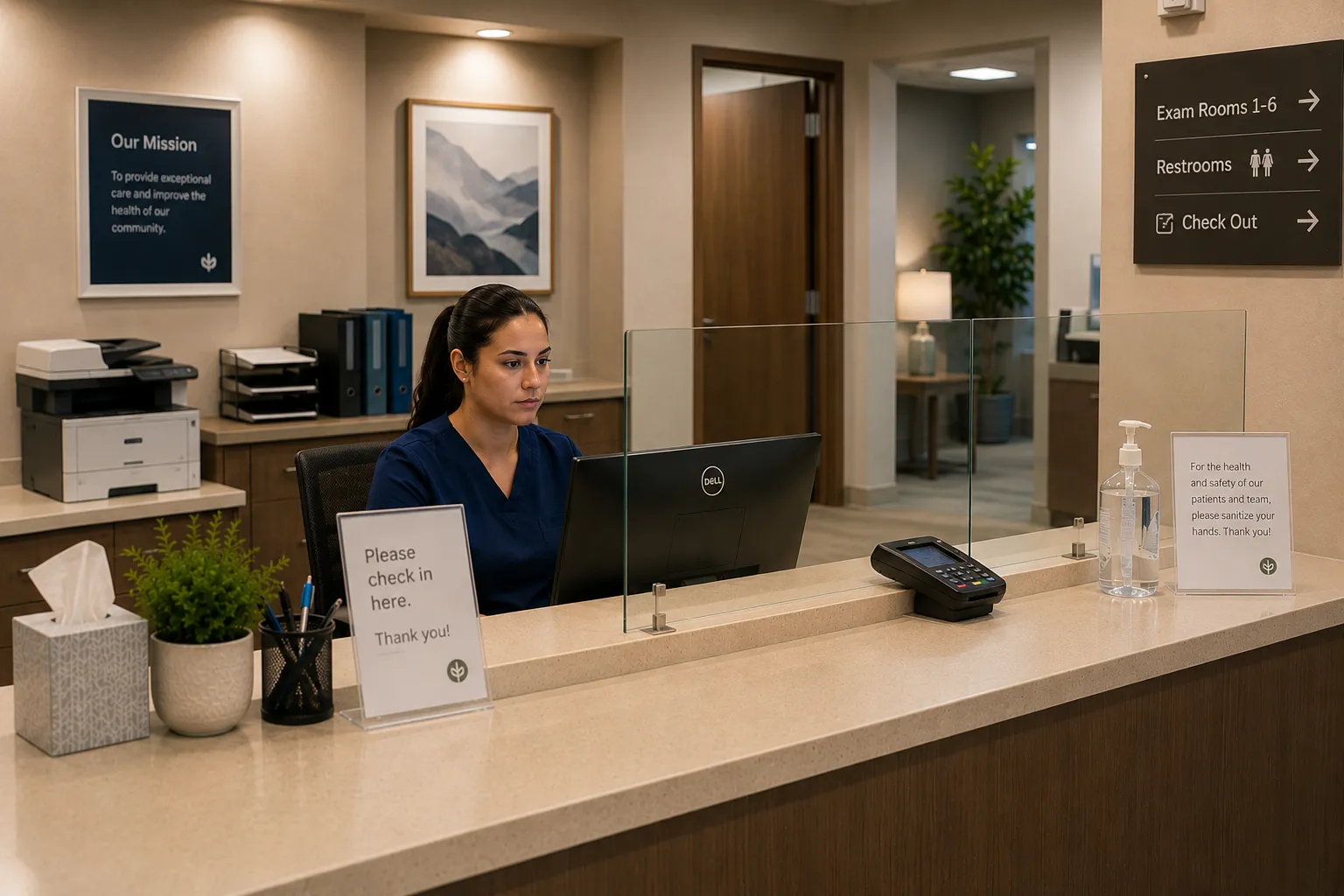
Whenever a new technology enters healthcare, the same question comes up: "Is this going to replace my staff?"
It's a fair question. Front desk staff already deal with enough operational changes. Staffing shortages, rising patient volumes, and insurance complexity have made healthcare administration harder than it was a decade ago.
Then along comes AI promising automation. It's understandable why some people immediately think the goal is replacing jobs. In our experience, that is usually not what clinics actually want. Most clinics aren't looking for fewer people, but instead looking for fewer bottlenecks.
The real problem isn't staffing. It's how staff spend their time.
Walk into almost any busy medical office and you'll see talented people spending a surprising amount of their day on repetitive administrative work. To name a few: checking insurance eligibility, entering patient demographics, calling patients who missed appointments, tracking down paperwork, following up on missing information, answering the same scheduling questions over and over again.
All of these tasks are imperative for a smooth running clinic, but very few require the skills that make great front desk staff valuable in the first place. Most front desk workers would rather spend more time helping patients and less time acting as human data-entry systems.
“Most front desk workers would rather spend more time helping patients and less time acting as human data-entry systems.”
What healthcare automation is actually changing
When people hear the word automation, they often imagine entire jobs disappearing but what usually happens is a bit less dramatic. Simply, the biggest change is that specific tasks become easier.
For example, instead of manually checking insurance eligibility for every patient, the system verifies coverage automatically. Likewise, instead of entering demographics from paper forms, information flows directly into the chart. And instead of spending hours calling patients about open appointment slots, outreach can happen automatically.
The role doesn't disappear, but the bulk of the work changes. In many of the clinics we work with, staff go from spending their day processing information to managing exceptions, solving problems, and helping patients navigate care. Those are often the parts of the job people enjoy most anyways.
Before and after healthcare automation
One way to think about this is to compare what a typical front desk workflow looks like before and after automation.
The workload does not disappear. It becomes more manageable.
- 1A patient calls with questions about scheduling.
- 2The front desk answers.
- 3The patient wants to verify insurance.
- 4The front desk checks eligibility manually.
- 5The patient schedules.
- 6The front desk enters demographics.
- 7The patient arrives.
- 8The front desk discovers missing information.
- 9The billing team later discovers an insurance issue.
- 10The front desk gets involved again.
- 11The same information gets touched by multiple people multiple times.
- The patient completes digital intake.
- Insurance is verified automatically.
- Demographics flow into the chart.
- Appointment reminders are sent automatically.
- Open schedule slots are proactively filled.
- Staff review exceptions instead of processing every transaction manually.
Patients benefit too
The conversation often focuses on staff, but patients feel these improvements as well. For example, they spend less time filling out paperwork, receive faster responses, encounter fewer insurance surprises, and they spend less time on hold.
Most patients care more about things being easy rather than whether a workflow is automated. However, when administrative work becomes smoother, both staff and patients tend to notice.
Where human interaction still matters
This is the part that often gets lost in discussions about AI. Healthcare is full of situations that require judgment, empathy, and flexibility. The scenarios range from a confused patient calling with questions about a referral, or someone frustrated about a bill, to a family member needing help understanding next steps, or a patient arriving anxious about a diagnosis.
AI isn't trying to automate away these important interactions since these are exactly where human staff create value. The more repetitive work technology can handle, the more capacity teams have for the moments that actually require a person.

“Patients rarely remember how quickly their demographics were entered, but they remember how your staff made them feel.”
How Beam approaches automation
Beam was never designed around the idea of reducing headcount. It was designed around reducing administrative burden.
Patient intake software helps collect and organize information before visits. Eligibility verification helps identify issues earlier. Documentation and revenue workflows help reduce downstream cleanup work. Communication tools help automate routine outreach and scheduling tasks. The common thread here is simple:
Take repetitive administrative work off the team's plate so they can focus on higher-value activities. In many clinics, that means fewer interruptions, fewer phone calls, fewer billing disputes, and fewer manual handoffs between systems. Not fewer people.
The future of healthcare operations is augmentation, not replacement
The clinics adopting automation successfully are usually not replacing their teams, but instead giving their teams better tools. The best front desk staff are still incredibly valuable. If anything, their value increases when they are no longer buried under repetitive administrative work.
Healthcare has never been a people problem. It has been a workflow problem. Technology is finally starting to help with that.
“The future of healthcare isn't fewer people, instead, it's giving the people you already have better systems to work with.”